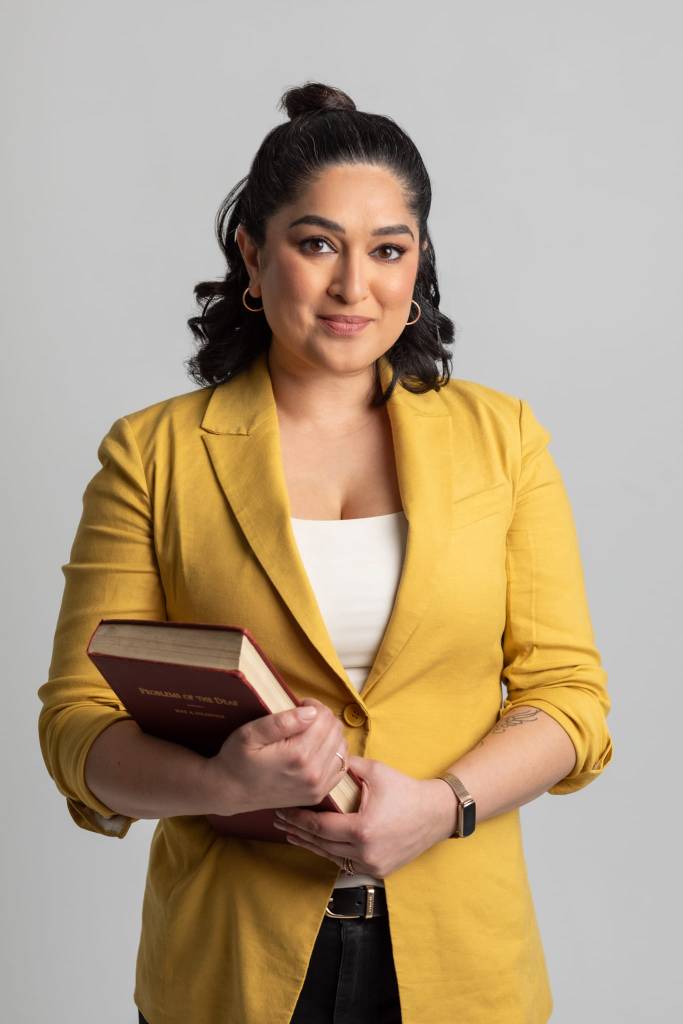
Dr. Jaipreet Virdi
is an award-winning historian whose research focuses on the ways medicine and technology impact the lived experiences of disabled people. Her first book, Hearing Happiness: Deafness Cures in History (University of Chicago Press, 2020) raises pivotal questions about deafness in American society and the endless quest for a cure. Her second book, Echoes of Care: Deafness in Modern Britain (McGill-Queen’s University Press 2025) examines the historical medicalization of deafness and its relation to healthcare access, cultural perceptions of disability, and the rise of eugenics–all of which had profound implications for deaf people.
She has published articles on diagnostic technologies, audiometry, hearing aids, and the medicalization of deafness and has published essays in The Atlantic, Slate/Future Tense, Aeon+Psyche, and the New Internationalist. She regularly makes print, radio, and podcast media appearances.
As an educator, Dr. Virdi has taught at the University of Delaware, Toronto Metropolitan University, the University of Toronto, and Brock University. She is currently an Associate Professor in the Department of History and Director of the Critical Humanities Commons at the University of Victoria.
If you’d like to invite her for a lecture, keynote, or another event, please contact them or fill out the contact form.
Born in Kuwait to Sikh parents, Jaipreet Virdi lost her hearing at the age of four due to bacterial meningitis. It was a challenging experience for someone so young, but little did she know that it would shape her journey to become an advocate for the deaf and hard-of-hearing community.
At six years old, Virdi and her family immigrated to Toronto, Ontario. Their arrival in Canada opened up a world of opportunities for her. She attended a school for deaf and hard-of-hearing children. Her educational journey took her through the realm of “mainstreamed” education, where she learned to lip-read and rely on her trusty hearing aids. She attended public high schools, navigating the challenges that came with communication in a hearing-dominated environment.
After completing her high school education, Dr. Virdi shifted gears into the fields of marketing and fashion merchandising. However, her curious mind and interest in the history of medicine and technology led her back to the academic realm. She decided on a career change to pursue graduate studies at the Institute for the History and Philosophy of Science and Technology at the University of Toronto.
Driven by her own experiences and a desire to shed light on the historical significance of medical advancements related to deafness and disability, Dr. Virdi embarked on an in-depth exploration of the field. She earned her master’s degree, then her doctorate, focusing specifically on the history of medicine and technology. Dr. Virdi’s doctoral dissertation, titled “From the Hands of Quacks: Aural Surgery, Deafness, and the Making of a Specialty in Nineteenth-Century London,” explores the journey of aural surgery and its impact on deaf people in British history.


Dr. Virdi is currently working on multiple projects. She is co-writing Standards of Pure Science: Phyllis M. Tookey Kerridge and Disability Research in Interwar Britain (Johns Hopkins University Press) with Dr. Coreen McGuire on a study of the historical roots of scientific research on disabilities–such as deafness and breathlessness–and the role of women scientists. Focusing on Phyllis Kerridge’s work, this study examines how scientific instruments were used by women to demonstrate the value of their research against criticism and to assert control over disabled subjects. Dr. Virdi is also writing Designing the Hearing Aid (in progress) which incorporates history of science perspectives to examine how the engineering and calibration of 20th century hearing aids were informed by design adaptions made by deaf people.
In addition, Dr. Virdi is working on a study of endometriosis based on her own experiences with the disease within the context of gender bias in medicine. She is also working on a new research project historicizing how disabled people tinkered with their prostheses and perceived their devices to be prosthetic extensions of themselves that were crucial for their self-crafting of normalcy. Through case studies of users adopting what Dr. Virdi refers to as “the disabled gaze,” this project forces us to confront how disabled people challenged medicalized assumptions about their bodies, and claimed their own spaces to craft their identity.
Jaipreet Virdi resides in Victoria with her spouse Geoff Bil, a historian of science and her hearing service dog Lizzie, while deeply missing her one-eyed, deaf rescue dog Benny who passed in March 2025.
 Dr. Jaipreet Virdi